Regenerative Landscapes

Regenerative Spaces

Creating healthier and more enriching spaces for all. 

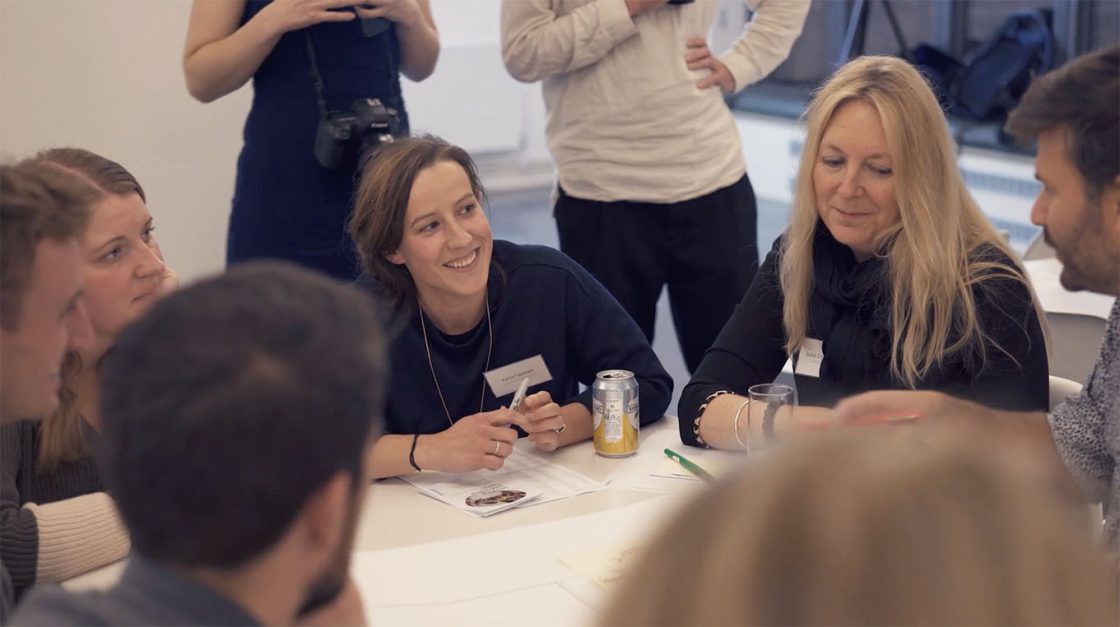
Towards the end of last year we attended a regenerative spaces event hosted by Azuko and Amos Goldreich Architecture. This week a video of the event and insights document were released. It was a thought-provoking event with so much passion in the room for making better, healthier and more enriching spaces. Here at Studio 31, we will always believe that landscape holds many of the answers to many of really big questions and emerging research supporting landscape’s integral role in health, wellness and climate change is testament to this but this event showed with absolute certainty that landscape is just one key element. Creating regenerative spaces is a truly multi-disciplinary task and events like these are blazing a trail in sparking cross-disciplinary conversations on these important topics. It was such a privilege to explore the inspirational work of other teams and organisations and consider how we could all work together for a greater good. Our thanks to people like Jo and Amos for bringing such a revolutionary group of people together.

Take a look at the video here.

And their Designing Regenerative Spaces insights document insights document here.

Please share their work and do head to Amos Goldreich Architecture or Azuko to join the conversation.

[Image is a still from the video of the evening so credit for this is theirs]
Prolandscaper Business Awards 2020

The values that drive Studio 31- Our win at the Prolandscaper Business Awards

Hope, imperfection and our moral compass. 

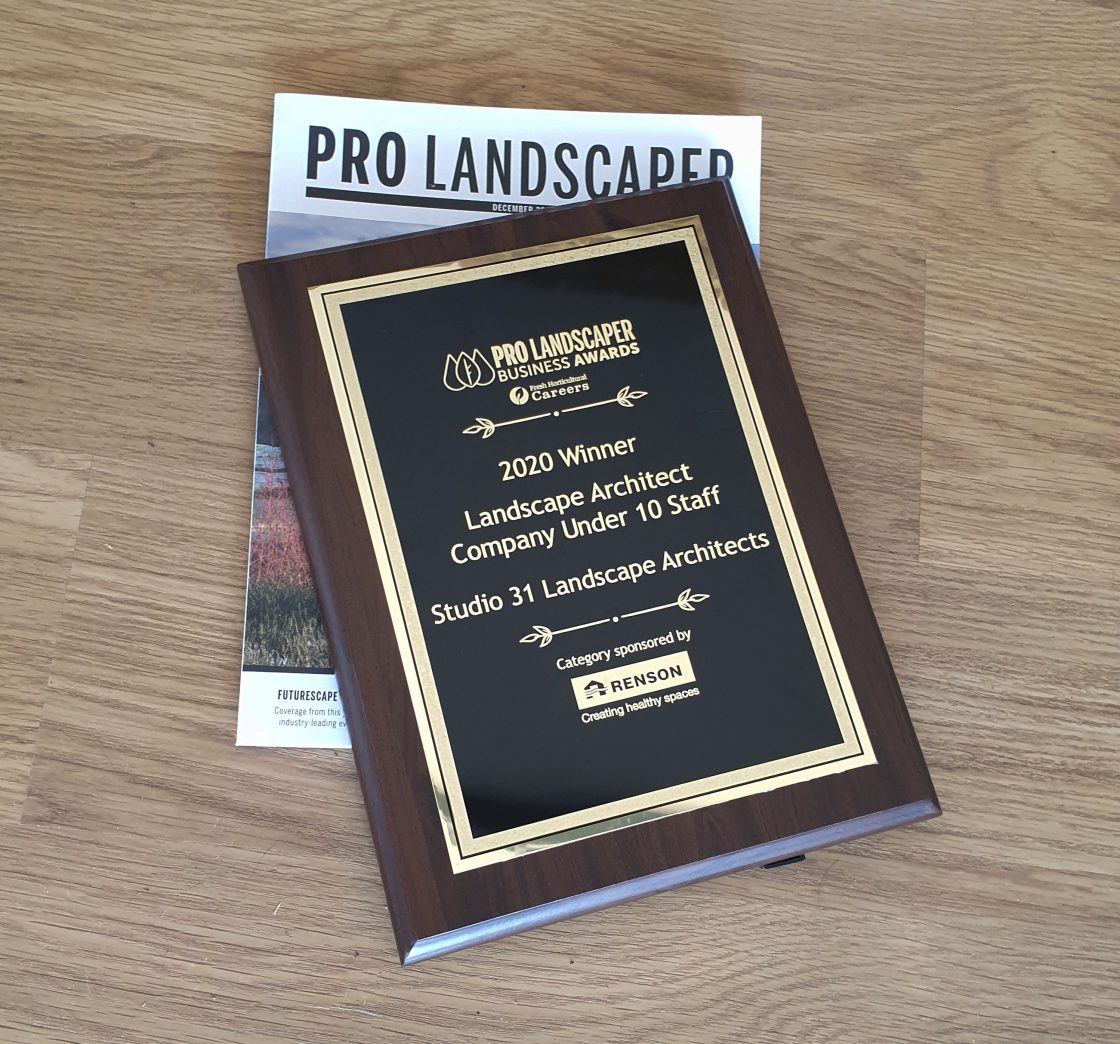
On Friday we won the Prolandscaper Business Award 2020 for Landscape Architect Company (less than 10 staff). Here, we are sharing our closing statement on our application for those awards which asked us why we should win and perhaps shares a little of the values which drive our practice.

Why should we win?

  • Because we are small, but we are mighty, we have big dreams and big ideas. We push every day beyond our boundaries and our size to be something more.
  • Because we believe that nothing good can be achieved in isolation, it needs collaboration, communication and partnership to create change.
  • Because we reach out and connect. We risk rejection and failure in order to form the relationships that will better the world.
  • Because we are a company of hope, spreading a message of hope. We know the negatives but what we also know is that we are in a position to change it. We want to be the problem solvers not the problem sayers. We want to spread hope, to convert hope into action and action into change and change into yet more motivation.
  • Because we understand the vitally important role of landscape architecture in shaping change.

Our ethics are not an add on but a core part of our business. This presents us with conflicts every single day. We don’t pretend to be perfect but rather perfectly imperfect. We make the best decisions we can, using our moral compass as guide. This means, we often choose to improve, rather than choosing only perfect projects. If we believe our involvement has the power to make something better, we act. We are constantly trying to be better; to review, to reflect and to react. We haven’t got exactly where we want to be yet but knowing that also means we have the flexibility to adapt our journey along the way. Why should we win? Maybe we shouldn’t, we’ll continue our course regardless but maybe winning would add a little wind to our sails and we believe they are sails worth filling.

Thanks to the judges and team at prolandscaper for putting a big gust of that wind in our sails. As it says above, we’re a small practice with big ideas and this was a moment of affirmation and motivation to help us continue to transform those ideas into action and create real change.

Do a little giving this Christmas

Christmas gifts, some incredible charities and a message of gratitude. 

As part of Studio 31’s ethos in health, sustainability and social change, we choose not to give material gifts at Christmas. We circulate electronic cards to our wonderful and valued clients and donate a to a landscape/nature-based charity on their behalf. To date we have donated the tools to build allotments for communities living in poverty in Rwanda, donated to The Garden Classroom (an outdoor education charity helping connect urban children with nature) and this year we will donate to a project close to our hearts The Pear Tree Centre for the ongoing maintenance of their new health and wellbeing garden there.

There are so many causes we would love to support, that often it’s overwhelming and difficult to know which ones to choose. We, therefore, choose to support nature-based charities, particularly those that connect landscape and health and who align with our values.

We are also lucky enough to know many other professionals and friends who run, raise valuable funds and advocate for equally incredible charities so if you want to change your company (or even personal) gift policy this year here are just a few ideas of some charities you could support…and when we say support, this doesn’t have to just be financial, even spreading their message helps others donate too…

  1. Azuko. An architecture charity using design to improve the lives of people living in extreme poverty and working to ensure every person enjoys the right to dignified living conditions. They are currently raising money to train women to “build for safety” in one of the poorest parts of Bangladesh where many houses are ill-equipped to face the growing number of natural hazards. This project really does have the power to not only change but save lives.

They are also running a bake-off style challenge between (today?!) 3rd-9th December so to get your workplace involved do contact them. Monies donated via their portal between 3rd-10th December will even be doubled!

  1. Shelter UK. “Homelessness is a national crisis” and architecture and the built environment could hold many of the solutions. Here is a link to one of our respected colleagues, Amos Goldreich talking about one such solution. His studio also happens to be undertaking a walk on 3rd December to raise vital funds for Shelter UK so do support them or the charity direct.
  2. The Garden Classroom. With more and more research emerging about the link between health and nature, it’s more important than ever that we connect children with nature. Not only this, but without connection to the natural environment there is limited incentive for future generations to protect it. Charities like The Garden Classroom give urban children the vital opportunity to experience nature first-hand.
  3. The Pear Tree Centre. A centre and health and wellbeing garden for anyone diagnosed with a life changing illness. This centre is holistic and community led at its heart and set to change the lives of hundreds of people with life altering illnesses. The team involved with this project really are a true inspiration and it’s a model that has the potential to inspire others to do the same.
  4. The Flying Seagull Project. This is a personal choice and such an important and relatively unknown charity. These guys believe that basic needs extend beyond food, shelter and warmth and that every human being also has a right to joy. They travel across the globe using play to bring laughter and joy to refugees and other children and communities that need it most. You need only look them up to feel their infectious enthusiasm and the true value of the work they do.

It isn’t within every person’s power, budget or business to be able to support charities like these but if it is, even on the smallest level and you are the budget holder or the influencer, be brave this year, do things differently, blaze a trail and maybe give a gift that gives a little more.

Above all though, breathe in love and breathe out gratitude.


Photo by Dan Gold

Sustainable Materials

Measuring environmental impact, a sustainable materials library and creating an environmentally conscious practice.

The trials and pitfalls of specifying low impact, sustainable materials. 

When we created the studio back in 2016, our vision was for it to be both good for people and good for the planet. When it came to the day to day running of the practice, this was easy. We are almost paper free, the marketing materials we do print use recycled paper and vegetable inks, we use compostable coffee pods, reusable cups, a renewable energy supplier, pay for additional recycling services and even our exhibition stands are waste free, right down to the plantable pencils for the kids to colour-in.

When it came to projects though, we found our idealistic views on sustainability infinitely harder. There are many factors contributing to this including budget constraints, product availability and the difficulties in measuring project sustainability.

We all know as built environment professionals, the first materials specified, are often not the end materials. This can lead to projects having an original sustainable material detailed which is later substituted for an unsustainable one. To combat this, we wanted to build a library of materials that we could offer to projects which varied in both cost and green credentials. Our aim was to be able to offer clients a spectrum rather than either/or scenario when it came to building their project more sustainably. This has proved more complex than we first thought and here’s why:

What is sustainability?

Sustainability is a term which simply relates to the depletion of the earth’s resources, which, when it comes to materials selection, is simply not a broad enough term.

Many people believe that just choosing a biodegradable or recyclable option is enough. Swap a plastic toothbrush for a bamboo one and you’re winning right? The trouble is that we don’t think about the production of that toothbrush; whether it’s flown or shipped thousands of miles, whether ancient forests have been replaced with fast growing bamboo, the manufacturing process and how long each product lasts. We aren’t saying bamboo toothbrushes aren’t sustainable, but the point is, a product is more than just the material it is made from. All the above aspects (and more) contribute to the life cycle of a product and ultimately its environmental impact. This means that a less “sustainable” but locally sourced and locally made product, can, in some cases, actually have a smaller carbon footprint than a more sustainable material made overseas.

So, what do we want from a material? Something sustainable? Something plastic free? Something with a low carbon footprint? The multiple definitions and ways of looking at sustainability and environmental impact makes making choices about materials extremely challenging and complex.

How do you measure it?

What makes this even harder is being able to measure the impact of our building materials. To date, there is no truly comprehensive tool for measuring the environmental and sustainability impact of a project and the host of information given by manufacturers and retailers can be confusing and often misleading. Take, for example, the many blogs citing the sustainability pros of using artificial grass. Many of these serve to justify its use and even some sustainability tools will suggest it as a substitution  for other carbon heavy materials. The problem being, that all of these omit the truly damaging environmental and ecological impacts of covering your garden with what is essentially a layer of plastic (a blog for another day).

Certain tools are beginning to emerge such as this design toolkit and measure tool by Climate Positive Design. Climate positive design is a pioneering project aiming to make all future landscape architecture projects not just carbon neutral but carbon positive. The tools they have created are useful for lots of reasons. They ask designers to consider the carbon impact right from the outset and give suggestions of simple material substitutions to reduce the carbon footprint of a project. This along with a focus on increasing the soft to hard landscaping ratio is all creating habitual processes designers can use from the very outset to adapt their designs.

This feels like the closest we have come to truly being able to measure the carbon footprint of our projects however, even this inspirational tool has real limitations. It looks at materials as generic; the general qualities of timber versus stone for example. But it doesn’t (as yet?!) seem to have the capacity to consider the manufacture process, provenance, sourcing, transportation or disposal of those materials.

When measuring carbon footprint, it considers a site as a blank canvas. By not considering what was there first, the results can be skewed. It can seem that a project with more than a certain percentage of soft to hard landscape will be carbon positive but site clearance of mature trees and planting replaced with 25% hard landscape for example will have a carbon negative effect. The tool, in this case, would show 75% soft landscape as carbon positive. The calculations also don’t consider ecological damage such as habitat destruction, fragmentation and disturbance. Don’t get us wrong, it’s a mammoth step forward and hugely important but we can’t let it make us lazy.

What we’ve learned

Assumptions. In beginning to build a materials library we have discovered that products we had assumed were unsustainable, in fact had more carbon positive properties than previously anticipated and ones assumed sustainable had their own downsides. Assumptions, it turns out, are a dangerous thing.

Supply Chain. We have also discovered difficulties with supply chain. We recently, for example, specified natural stone paving which we were assured (amongst other attributes) was sourced and distributed from the UK. What we later discovered was that this product, though sourced in the UK was then shipped to Europe for manufacture and back to the UK for distribution. This massively increased that materials’ carbon footprint and was hidden from the consumer (us) with clever wording.

Judgement Calls. Considering sustainability is a series of trade-offs and, without real, comparable numbers, often feels like making judgement calls. As another example; we have spent many hours considering the relative merits of porcelain versus natural stone. Porcelain being a product that essentially utilises bi-product material (recycling) where natural stone draws directly from the earths resources. This, at face value, makes porcelain a better choice. However, porcelain undergoes a much more carbon heavy manufacture process using kilns which often run 24 hours a day. Natural stone conversely, has a much lower impact cutting process. Which then is the more environmental choice? Timber I hear you cry! Absolutely in terms of carbon capture and end of life disposal but even timber is not without its own issues in terms of sustainable sourcing, deforestation and longevity. And all this not withstanding client preference and budget constraints.

Is there a solution?

Suppliers. What we are doing is holding our suppliers to account. Asking them for the sustainability credentials of not only their products but also their businesses. Asking them to care, to understand and above all to know the answers. And slowly, slowly, we are building a library, adapting, changing the materials we use and when we find something we don’t like, seeking out new suppliers, new materials and new technologies. We have an open door to suppliers to who can prove to us their product is a more environmental and healthier choice.

Clients. We are attempting to arm ourselves with enough information about products. to be able to offer realistic alternatives when budget or other factors constrain. An example of this is a large healthcare project which was subject to budget cuts and therefore asked to down specify a large area of terrace. Their suggestion of a product they had previously used (and seen be successful in health setting) would have greatly increased the overall carbon footprint of the scheme. Our recognition of this meant that we could suggest a material with 80% recycled content that both met their budget constraints and provided a more sustainable solution. Just as our clients aren’t designers, they also aren’t sustainability experts therefore education is key to support our clients make truly informed decisions.

Professionals. We are building relationships with like minded professionals. Ones who care about their environmental impact and ones with whom we can share knowledge and draw from their expertise. A series of symbiotic relationships to keeping driving sustainability in the built environment forward.

Conclusion

This isn’t a perfect world, there are no perfect projects and certainly there are no perfect products (perhaps excepting trees) because every product takes something from the earth in some way. But… we are passionate about our ethics and trying to be a moral compass, sustainability advocate, educator and environmental champion on the projects we are involved in. Our hope is to make them better through our involvement, better our own practice in the process and perhaps inspire other professionals to move with us along the way.

Watch this space for a follow up blog on questions to ask your own suppliers regarding sustainability.