Contemporary Garden Design Essex

Project Update: A Contemporary Garden Design in Essex

The Importance of Design Collaboration

We are in the midst of the detailed design stages for our contemporary garden design project in Essex. With the conceptual design phase for the landscape complete, work on the building is due to commence in the coming weeks with the landscape construction to follow later next year.

This project really highlights the importance and advantage to the client of a collaboration between an architect and landscape architect in the initial design stages. The benefits of this early strong working relationship can be many fold; not least to ensure that the quality and level of detail evident the design for the architecture is continued and congruous within the landscape but also for practical and cost-effective reasons.

On this site, design work for the landscape at this early stage has meant the opportunity to plant mature hedging around the boundary of the site in advance of the architectural build commencing. One of the main concerns with the site for this project was the imposing boundary of the neighbouring property. Planting mature hedging at this stage is a cost-effective way to mitigate against this problem. The 18-month construction period gives the plants time for growth and to establish further, thus allows for slightly smaller initial plants to be used.

A good collaboration between architect and landscape architect will develop cost-effective solutions such as this in order to provide the best possible overall delivery of the design in the most efficient way.

Of course, there are disadvantages to planting pre-construction as plants can be sensitive to the impact of heavy machinery and can be liable to damage during construction phases. With this in mind, it is also important to have a good working relationship with the main contractor. Good contractors will be well used to putting in place protection for sensitive landscapes (such as trees with preservation orders) so clear communication here should easily mean provision can be made.

With this site, the hedging is located well away from the main construction area and can be easily fenced from the building work, therefore any impact to the plants can be avoided.

The design itself is an exciting one, providing a seamless link between the building and the wider landscape through using the continuation of themes from Clear Architects’ contemporary building design into the garden. An example of this, is a linear cascading water feature which breaches the two levels of the terrace. We are excited to see the building begin to come to life and the landscape with it over the coming months and are working closely with our colleagues at Clear to ensure the results are something astounding.

For more information or photos, see our portfolio page here.


Garden Design Essex. Garden Design Hertfordshire. Garden Design Suffolk. Garden Design London. Garden Design Kent. Landscape Architecture Essex. Landscape Architecture Hertfordshire. Landscape Architecture Suffolk. Landscape Architecture Kent. Landscape Design Essex. Landscape Design Hertfordshire. Landscape Design Suffolk. Landscape Design Suffolk. Landscape Design London. Landscape Design Kent.

Horticultural Science

Horticultural Science and Research at RHS Wisley

Education, Science and Learning

This weekend we took a trip to visit flagship RHS site Wisley in Surrey to get a closer look at Wisley’s portion of the RHS 160 million pound development. Wisley is one of the UK’s best loved gardens, welcoming over 1 million visitors per year and is well known for being a great day out for garden enthusiasts, families and professionals alike. What it’s less well known for though is its history and credentials in horticultural science that’s what this expansive new development is hoping to put right.

Wisley has been home to RHS Science since 1903 and RHS School of Horticulture since 1907 where a team of botanists, scientists and horticulturists have, to date, compiled some of the most important horticultural collections in the UK, if not the world. Their database alone houses 325,000 plant names and they have cultivated over 80,000 plant specimens in the RHS Herbarium. The existing grade II listed garden was originally designed to be a “living laboratory for experimentation and education in horticulture” and to this day provides a foundation on which scientific research there tackles globally important issues.

The new development at Wisley aims to open the laboratory to the public for the first time in over 100 years and aims to be both a step back in time to explore how scientists pioneered horticultural research and also a classroom for the future, lifting the lid on the latest scientific advances in botany and horticulture.

As part of the development, there will also be seven new gardens, some of the most interesting of which surrounding The Centre of Horticulture, Science and Learning. The three gardens here will focus on mental health and wellbeing, gardens as ecosystem services and also a brand-new kitchen garden teaching people about our connection to the natural world through the food we eat. Each garden having a unique educational focus like this, really grounds the theory in practice, thus making it more tangible and palatable for its visitors.

The great part about this development is that there is this keen focus on learning. The RHS is aiming to encourage future generations to “embrace all aspects of horticulture and understand its value and importance”. This is something vital  in a world where technological and scientific advances are so often perceived as synonymous with indoor pursuits.

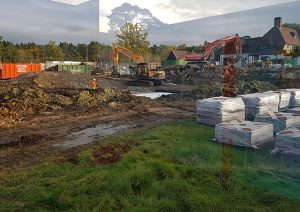
For so long now, science and research has been something conducted behind closed doors, only put on display once the reports are written and results are validated. The work at Wisley is attempting to turn all that on its head and quite literally open its doors to the public in a bid to help engage and educate all of us. And in relation to this new idea of transparency, they’ve already started as they mean to go on with a ground level viewing platform of the building work as it occurs. An absolutely genius idea, though, we probably spent a little too long watching the diggers.

Horticultural Science

Wisley have long-since had a mission to “Enrich everyone’s life through plants and make the UK a greener and more beautiful place” and from next Summer we will begin to see how they are fulfilling that objective. Great work Wisley, here at Studio 31, we look forward to seeing the work unfurl.

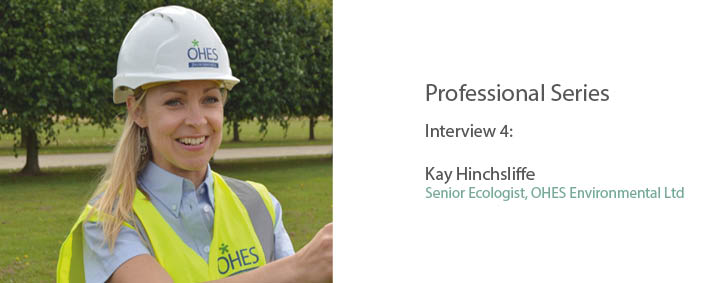
Senior Ecologist

The fourth in our monthly professionals series; Kay Hinchsliffe, OHES Environmental

 Kay Hinchsliffe; Senior Ecologist

This month we were privileged to share the company of Kay Hinchsliffe, Senior Ecologist at renowned ecological specialists OHES Environmental. Unusually, I’ll leave the opening gambit to Kay, whose eloquence (though I tried, believe me), can’t be bettered…

“A childhood spent in the countryside pond dipping, dung hunting and woodlice collecting has inevitably led me to this career path – which is apparent in hindsight, but not necessarily throughout the journey. As a young adult and after a little travelling and soul searching, determined that I would single-handedly save the world, I completed a degree in Environmental Sciences. Here, I had some inspirational tutors who gave me the belief that everyone can make a difference in their own way to the environment – whether that be simply turning off a light or changing internationally policy.”

Kay has never stood still in her career, beginning life as an academic Research AgroEcologist and then Ecology Consultant before achieving her species licences and professional accreditations and taking up her current specialist role.

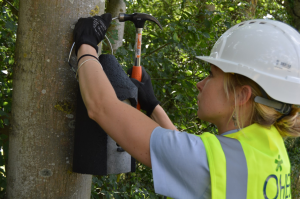
It’s evident the moment you begin to talk to Kay that she has a deep-seated love for the natural world and thrives on the diversity of her work which takes her from bat box consultancy at central London hotels, to knee deep sampling fish populations in rural Wales. She’s even designed mitigation to reduce the interplay between badgers and fighter jets on a MoD airfield but her favourite part of all is…

“working in remote sites, where you are reminded how small you are (and indeed your role is) in the grand context of the landscape and the natural environment”

It all sounds rather like a dream job so we asked her what the downsides were…

“Without a doubt, the physically hardest part of the job is the 2am alarm which precedes a dawn bat survey. There is no feeling quite like jumping out of bed, straight into your waterproofs with bat detector in hand, followed by standing in the dark for a few hours in the hope of catching a glimpse of illusive bats returning to their day roost as the sun rises…And the gratification of knowing that once you have found that roost, the bats within it, and indeed their surrounding habitat, will be protected and their longevity within that landscape maintained…”


Ecologist


Kay’s views on landscape and the environment are insightful, articulate and represent the much needed shift in attitudes that will serve to preserve this world for future generations

“We are all connected, whether by choice or not, to the landscape and our environment. Indeed, we all passively impact upon it and reciprocally the changes in the environment impact the way we live our lives now and in the future. Our connection with the environment is innate and deep rooted. I consider that we are custodians to this wonderful earth and it is our duty to work with the environment to facilitate the inevitable growth and development of humankind whilst reducing our adverse impacts and ensuring we pass on an ecologically diverse legacy to future generations.”

A big part of landscape architecture and indeed architecture can be working with ecologists to mitigate against environmental and ecological damage so we asked Kay what her views were on working with professionals in the landscape design industry.

“Good landscape design can benefit the ecology of the natural environment. I regularly work with Landscape Architects at the design stage of build projects where, as part of the wildlife mitigation, and thus planning condition, it is imperative that the site does not have an overall negative impact on the site’s ecology.”

Kay works with landscape architects to help them build solutions into their designs that overall create a net gain for wildlife. It would be easy for her to be viewed by professionals as a OFSTED style inspector, hindering urban development but it’s clear that Kay’s approach is one of collaboration rather than dictatorship and it’s our view that this method of nurturing strong professional relationships provides the best results for the ecology in both the short and long term. She takes the view of educating her clients and partners, thus building in good practices and policies that they can replicate on future projects.

At Studio 31, we consider ourselves conscientious landscape architects and it’s professionals like Kay that support us in improving our designs and methods for the greater good. It’s fair to say that most people we meet across this industry love their roles but with Kay it radiates from her very core and that is quite literally contagious.