

How to build the perfect grass amphitheatre
What a fun couple of weeks we have had taking it in turns to go to site to see our grass amphitheatre design come to fruition. In light of this and not in our usual blog style, we thought we would offer some top tips for creating the ideal amphitheatre:
Consider the design. Do you want your grass amphitheatre to grow above ground, dig down below or a bit of both? Remember that you may require planning permission depending on the site and design so it’s always worth seeking advice. Consider also, the use of the amphitheatre. Is it an entertaining or a social space? Will you be using it as an intimate space for an open fire or more of a public area for a theatre/concert? All these aspects will dictate the shape, size and design of the amphitheatre itself.
Know your soil. You need a soil which will retain its shape but also have an element of free drainage. Too sandy and it won’t hold its shape, too much clay and you’ll have issues with drainage. A good loamy soil with some sand content usually works well. Good quality suppliers can help you here.
Layers. Build the mound up in layers, compacting as you go. Usually an amphitheatre starts life as a general mound shape which is compacted and then from there you can cut in your desired shape.
Keep the face slightly damp. Don’t let your mound dry out too much before you apply the turf.
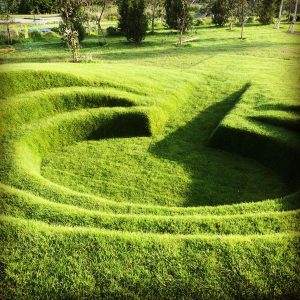
It’s a good idea to let your finished mound shape settle before you apply the turf. We left ours for a week and then did some final finessing of the shape by hand before the turf was applied.
Know your turf. A grassfelt like the one we used from Lindum turf is ideal. It’s a soil-less grass growing in felt which holds the soil in place below whilst the turf establishes. Moreover, because grassfelt is grown for its strength and flexibility, it is easier to lay and retains moisture better.
Water it! Once you’ve finished your mound, just like any newly laid turf, you need to water it. Be cautious though that you aren’t too over zealous because if water gets behind the turf, it will affect the shape of your mound. With the weather so hot, this has been the hardest part of the project for us.
A good contracting team are essential here. We used a digger driver with a lifetime of experience and watching him work was a joy. The digger was an extension of his body and the smoothness with which he carved the design was akin to an artist at work. Some of our team were so inspired, they even chose to get their hands dirty and join in with the finite detail of the build.
It’s not clear whether it’s the client or us who is more overjoyed with the results but it’s been a pretty special project to be a part of all round. The family plan to use the amphitheatre for intimate social gatherings huddled round an open fire and in the summer month’s private parties and performances by their very talented friends and family.
It’s a tricky process to get right and our advice would be if you don’t feel confident to go it alone, getting a professional landscape architect like Studio 31 involved can often be the best route. That way, you can let someone else take care of the planning and logistics and be confident that the end result will live up to all your expectations.

