landscape

Our Favourite Landscape Podcasts

Landscape Architecture, Nature and Horticulture Podcasts to brighten your festive season.

Christmas is the time for sharing and we thought for Studio 31s final blog of 2017 we would share with you some of our favourite landscape architecture, horticulture and nature podcasts. If you’re travelling back home this Christmas or just fancy kicking back with some mulled wine and a mince pie, here are some perfect accompaniments. Get downloading.


  1. Field Guides

A podcast focussed on North American wildlife but aimed at bringing its listeners out on the trail with its passionate and knowledgeable hosts Steve and (Mr) Bill. Field guide podcasts are thoughtful, insightful and target both flora and fauna (after all they are inextricably linked). A must for your inner nature nerd.

Average running time: 60 minutes

Frequency: Monthly

Website: http://www.thefieldguidespodcast.com/


  1. Common Edge

This non-profit organisation is worth following, as is their monthly (or sometimes a little less) often podcast. They have a mission to “reconnect architecture and design with the public that it’s meant to serve” and they report on public engagement in the planning and design of the built environment. Their podcasts target some important issues such as sustainability, climate change and social justice as well as citing the role of landscape architecture in the build environment.

Average running time: Varies from 30-50 minutes

Freqency- Ad hoc (A little less than monthly)

Website: http://commonedge.org/category/podcast/


  1. Sod Show

An award-winning garden podcast hosted by horticulturist Peter Donegan. SodShow comprises weekly interviews with a whole range of industry professionals in what are often funny, sometimes moving, always informative interactions.

Average running time 30minutes

Frequency Weekly

Website: http://www.sodshow.com/catagories/sodshow-shows/


  1. Remarkable Objects

A podcast taking a look at the ways in which nature and the built environment shape each other. It is created with the idea in mind that if we can incorporate nature into our cities we can create healthy, sustainable places for people. These are conversations that will advance our thinking in this realm.

Average running time- 20 minutes

Frequency- Roughly 2 weekly.

Website: http://www.remarkableobjects.com/episodes


  1. In Defense of Plants

“Plants are everything on this planet.” “From the smallest duckweed to the tallest redwood, the botanical world is full of amazing evolutionary stories.” This is a podcast for plant geeks everywhere, hosted by the insightful and infinitely knowledgeable Matt Candeias. It’s more sciency than some of the podcasts out there so expect a few latin names and mind-melding moments but it’s also very accessible too. Targeting important topics like sustainability, conservation, climate change and ecology, this podcast is a regular in the office here at Studio 31 and is raising the flag for flora large and small around the world.

Average running time: 50 minutes

Frequency: Weekly

Website: http://www.indefenseofplants.com/podcast/


A very Merry Christmas and Happy New Year from the team here at Studio 31. See you in 2018 where we will be continuing our professionals’ series, sharing more of our own work and looking at more important issues across the landscape industry.


Garden Design Essex. Garden Design Hertfordshire. Garden Design Suffolk. Garden Design London. Garden Design Kent. Landscape Architecture Essex. Landscape Architecture Hertfordshire. Landscape Architecture Suffolk. Landscape Architecture Kent. Landscape Design Essex. Landscape Design Hertfordshire. Landscape Design Suffolk. Landscape Design Suffolk. Landscape Design London. Landscape Design Kent.


Photo by Geran de Klerk

Studio Update: Planting Mature Trees

Planting Mature Trees

We’ve had an exciting couple of weeks here at Studio 31; competition deadlines, co-ordinating builds and some adventurous conceptual design work in full swing!

Among all the (happy) chaos, we wanted to come up for air to talk about one of our favourite things; trees. Big trees.

On one particular day last week, two of our team were out on two very different sites, in two different counties with two very different sets of weather but both taking delivery of some evergreen, mature, native trees. Up in Suffolk, it was -3 degrees with snow storms whilst in balmy Hertfordshire there was blue skies and the perfect sunny winters day (not sure who got the raw end of the deal there).

At one site thirteen 3 metre Pinus sylvestris (Scots Pine) were delivered to one of our commercial clients to be used as part of a unique entrance way. At the other residential project eighteen 7 metre Ilex aquifolium (Common Holly) were being delivered as part of a screening programme. These were mature trees weighing in excess of a tonne and requiring specialist equipment and expertise in both transporting and planting. These types of installations are where our network of professional partnerships with high quality suppliers and contractors really come into their own and allow the trees the best start to begin to thrive in their new homes.

Planting Mature Trees Planting Mature Trees

Whilst the debate rages on in landscape and ecology realms about the benefits of native versus non-native (in terms of biodiversity), on these schemes native trees were the right choice. At both sites, the respective trees are building on the existing ecology and habitats by echoing the local flora and surrounding woodlands and with both species being evergreen, they will have the advantage of fulfilling their roles all year round. As with all our schemes, we look to provide planting which carefully considers the needs of the site, the client’s brief and it’s ecological and environmental impact. Planting big, beautiful native trees is an easy win for us as it fulfils all our objectives with ease.

Architects

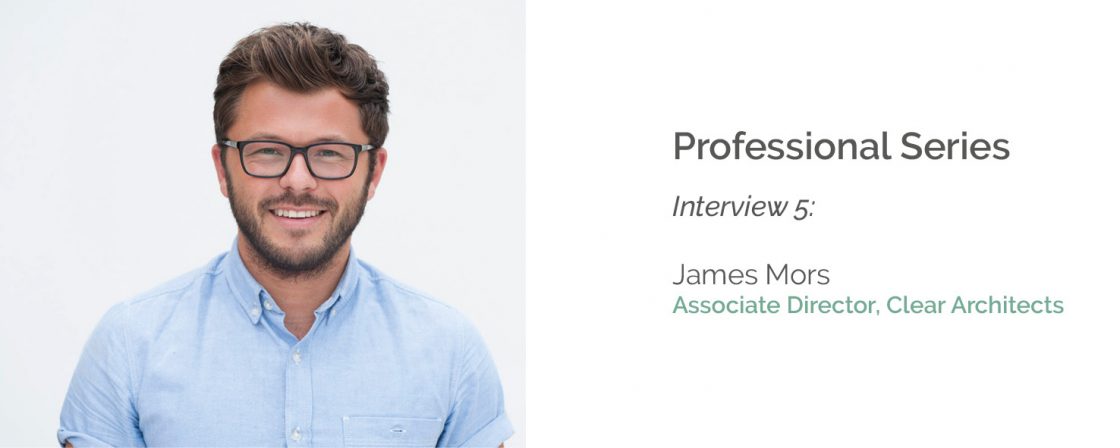
The fifth in our monthly professionals series; James Mors, Associate Director, Clear Architects

 James Mors; Associate Director, Clear Architects

There are many definitions of the term ‘Landscape but one of the simplest is ‘anything that is not a building’ and as such ‘landscape’ is a term that extends from the wilds of mountains and moorlands to the confines of private gardens, public parks and the spaces between buildings. It is, in a sense, an all-encompassing term and as such this blog aims to begin to help people think about the diversity of the landscape profession and those professionals within it.

This month’s interview is with James Mors, Associate Director of the innovative and inspired Clear Architects which may lead you to thinking ‘what has an architect got to do with a blog about landscape professionals?’ If the definition of landscape is ‘anything that is not a building’, then the answer to that question is…a very great deal indeed.

A huge amount of the work professionals across the landscape industries do is to look at the connection between architecture and landscape. And as such architects and landscape professionals are, and will continue to be, inextricably linked.

James came to work at Clear Architects after having started his professional career in commercial focused architecture. Here he gained a core understanding of commercial projects under design and build contracts but over time, also a desire to connect more closely with the end user. The move to Clear, offered him just that and it’s apparent immediately that James sees the value and indeed privilege in being trusted to “design [clients] dream homes and spaces they never realised could be a reality”. His passion, in his own words, is “in designing and creating unprecedented spaces”

When you learn a little more about James, you come to understand that his affinity with architecture extends well beyond design alone. Perhaps stemming from a childhood love of building and creating things “a table, chair or scaled model”, James has as much interest in building as he does with design and describes his role in the construction of projects with equal levels of fervour as the design work itself.

No surprise then, that Clear architects was a perfect fit for James;

Clear Architects have never aspired to create designs that are never intended to be built and push relentlessly to ensure projects are constructed to the highest quality. The practice is all about the detail and ensuring our clients aspirations are exceeded. 

Too often architects are criticised for inspired conceptual design work with no consideration of how that architecture may practically be built. Both Clear Architects and James himself, break the mould in this respect. It is obvious that for James, the design and functional aspects of architecture go hand in hand.

My taste is minimalist.  I believe the key to good design is to not over-complicate details and design in general.  There are simple factors that should alwaysbe considered; orientation, topography of the land, site location; A project must always consider the core values of the site.  Simple lines and well-arranged spaces that are practical and function for the end use.

It follows then that James considers the execution of a building to extend beyond the role the architect alone and he describes his professional relationships as “paramount to creating excellent architecture”

Excellent design/construction can only be realised through collaborative working

[Clear Architects] surrounds itself with likeminded individuals and professionals, as there is an appreciation that creating buildings to the highest quality does not lay solely with the architect, it is a combination of many professionals.

In this vein, James considers the connection of landscape and architecture to be essential.

Some of our best concepts have been developed and inspired from the landscape/context that the building sits in.  I believe that the landscape architect should be part of the design team from the outset, bouncing ideas with the architect to ensure the landscaping is not an afterthought.

James’ expertise in the translation of good design into practical construction is certainly an asset here. He describes the importance of the involvement of landscape in the early stages of design and a necessity to remain open to adjustments in the design of the architecture to better connect building and landscape. In essence, James’ approach is to try to create one design which flows from architecture to landscape architecture and he advocates the value of this method to the architecture itself, to the landscape and ultimately to the client. It is a truly holistic approach to architecture that produces some quite remarkable results and makes it both a pleasure and a joy for Studio 31 to work alongside James (and Clear) on some truly astonishing projects.


Garden Design Essex. Garden Design Hertfordshire. Garden Design Suffolk. Garden Design London. Garden Design Kent. Landscape Architecture Essex. Landscape Architecture Hertfordshire. Landscape Architecture Suffolk. Landscape Architecture Kent. Landscape Design Essex. Landscape Design Hertfordshire. Landscape Design Suffolk. Landscape Design Suffolk. Landscape Design London. Landscape Design Kent.