A legacy beyond us.

A visit to a private nature reserve in Sussex brings unexpected design lessons.

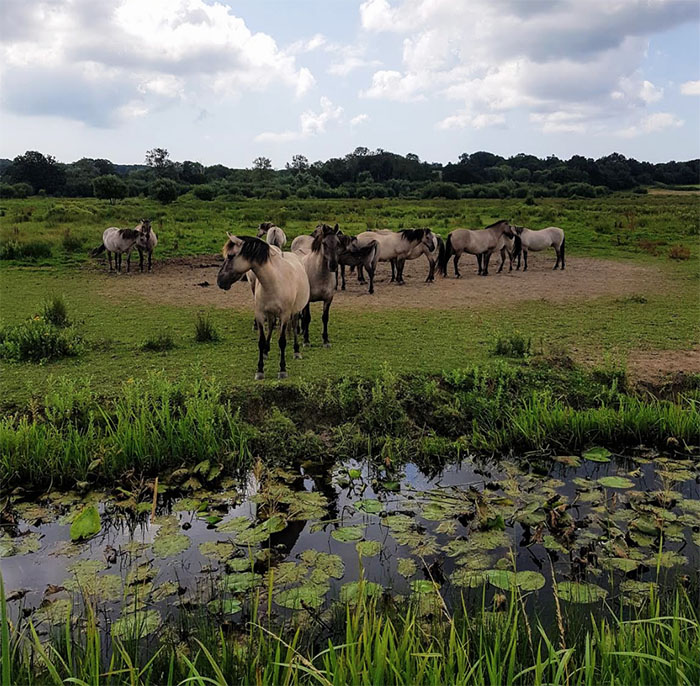
Last month, we had the privilege of visiting a 350-acre privately owned nature reserve in East Sussex. The reserve was the brain child of the passionate Philip Newton and began as nothing more than a mere 4 acres and a vision. It is now owned and run by The Maxfield Nature Conservation Trust and boasts more than 350 acres of re-wilded abundance.

Almost everywhere you look, it is brimming with life. Crickets and grasshoppers flick at your feet whilst damselflies and butterflies colour the air. A brief ten minute birdwatch records over 20 species from nuthatch to buzzard and the moth trap catch beggar’s belief. You cannot rest your eyes here, there is always something to draw them. Always some other wild wonder to drink in and all that’s discounting the rich flora that is the beating heart of this place.

It is peaceful here. A silent retreat, a place to be, to observe, to feel small. This is sympathetically managed land, largely left to its own devices. Sensitively grazed by a small herd of Shetland Cattle and wild Konik ponies, its conservation strategy echoes that of other local areas like Friston Forest. There is a demonstration here that although it feels like the land is untouched, this is a joined-up attempt at getting the best from this place; giving nature the best chance.  Through minimal intervention, Philip has created thriving wetlands here, havens for birds, insects and arachnids whose habitats are ever decreasing in other parts of the UK. There are wildflower meadows rich with life and woodlands where aerial friends can rest.

Zipping through this place on Philip’s nature safari, three hours passes in the blink of an eye. We stop every few hundred yards; something else to look at, something else to learn. My heart is full here, my mind still. I recall many of the health research papers exploring what makes a healthy place. This has so many of the perceived sensory dimensions associated with health promotion; serene, space, nature, rich in species*. Perhaps that is why I feel as I do.

Driving away, thinking about the wonder of this place, there are three things I take away.

One. let it never be said that a single person can do too little. We cannot all build a 350-acre legacy but the way we tread our paths with nature, lift our heads to see it and open our minds to learn about it can have a greater impact than almost anything else.

Two. Here is, yet again, another argument for light touch, re-wilding, doing more by doing less. Our clipped verges and mown lawns are traditional in their design but do not bring with them abundance. We need to think differently about design, about maintenance and perhaps about beauty itself. After all, with regard to nature; with abundance comes beauty.

Three and perhaps the poignant lesson here. This may be a private nature reserve, but it isn’t a private enterprise. Philip shares it with conservation experts; individuals with their own agendas from increasing rare spider populations to recording birds and also with larger organisations like the Sussex Wildlife Trust who can use this place to research and record. This is a personal project but a future one too, it is his desire that, in time, this place will end up in the hands of a wildlife conservation organisation and wheels are already in motion for this to happen. The legacy of this place will live well beyond its architect. And in todays’ world that is truly innovative and truly forward thinking. What we need to do now, is create places that aren’t for us but instead that live beyond us. And surely, we as landscape architects are some of the best placed professionals to do that…
design lessons

*Stigsdotter and Grahn (2010) The relation between perceived sensory dimensions of urban green space and stress restoration. Landscape and Urban Planning. 94: 3-4

An interview with Matthew Pottage, Curator of RHS Garden, Wisley

Matthew Pottage, Curator RHS Garden, Wisley

This month we had the privilege of interviewing Matthew Pottage, Curator of Royal Horticultural Society Garden, Wisley.

Just to give some context to Matthew’s job, RHS Wisley is a 240 acre site, visited by 1.2 million people annually. Wisley employs some 75-garden staff, 25 students, four apprentices and 100 volunteers and Matthew’s role is to oversee the plant collection, gardens in which they are displayed and all the staff and volunteers who care for Wisley.

No small task then, but who better to take on that challenge than someone who has lived and breathed Wisley since the inception of his career. Matthew trained with the RHS as a student at Wisley and worked his way up ‘through the ranks’ from student to Curator over a ten year period.

His dedication to the collection of plants there is such that he studied for the RHS Master of Horticulture alongside the demands of his day job and his passion for people’s relationship with plants was one of his main drivers for becoming curator of RHS Wisley.

Inspiring people with plants and creative display excites me, and how better than being the Curator of a garden that is visited by some 1.2 million people annually?! I also love cultivated plants so the RHS remit really appealed to me, as we do not ‘stamp collect’ species plants, and we have a lot of freedom how things are laid out and displayed”

I imagine there are a lot of favourite parts to working somewhere like Wisley but for Matthew it is seeing the garden develop, evolve and improve. Testament to the humble nature of his character he believes that this evolution “is through the great work of my team, which, from a management point of view is about recruiting and developing talent and giving people space and freedom to do wonderful things.” Showing, as all great curators do, that the things worth doing are rarely a solitary venture but a group of passionate people inspired by the steady hand that guides them.

Unsurprisingly, managing a gargantuan project like Wisley also has its challenges in the shape of the pure volume and breadth of work involved but as Matthew puts it;

“The RHS is a very inspiring charity to work for, and the extent of work is quite phenomenal. I always feel proud to wear my RHS name badge”

Matthew’s inspirations are many from “planty conversation with the likes of John Grimshaw, Roy Lancaster or Helen Dillon, all of whom are generous, knowledgeable and incredibly lovely people” to designers like Piet Oudolf, Arne Maynard and Chris Beardshaw’s [whose work is in] contrasting styles but full of personality and interesting plants.”

Thinking about professionals like these, the other great thing about Matthew and the RHS more broadly is their readiness to use the expertise and experience of other professionals to really get the most from a garden or project. This includes working with exceptional designers.

“Showcasing design does come into play at RHS Gardens, and when we refresh a large garden area we often work with external designers. I believe this works best when the RHS team plant knowledge informs a planting plan that fits with an external designer’s plan. A huge success at Wisley is the Bowes Lyon Rose Garden where a combination of my team’s plant knowledge and Robert Myers’ brilliant design literally transformed part of the garden that is now beautiful and full of interesting plants.”

Those who regularly follow us, will know that, here at Studio 31, we are passionate about the link between design, health and landscape and it’s great to see professionals like Matthew engaged with the topic of well-being and spreading the message about the value of landscape and “power of plants”.

 The power of plants and the wellbeing they bring us is so important and was seemingly undervalued. Cultivating plants, gardening, creating something beautiful in your back yard is so stimulating and rewarding, I feel passionately that those who have a love of gardening should try and spread the word! I’m really pleased the topic of mental wellbeing through gardening is now getting airtime – surely a positive forward step.”

Interviewing Matthew, you get a sense from him that two things are what makes him so good at his job; an innate and unashamed love of plants;

“I do believe I’m branded a bit of a conifer fanatic, which is true, I do like them, but I love a huge range of ornamental plants from houseplants to trees and don’t mind putting my head above the parapet if it happens to be unfashionable!”

And a gusto to take a risk and try something new. In fact, when we asked him what one piece of garden or landscape advice he would give everyday people, his answer was this:

“Never be afraid to do something different or try something new. With worries around new pests and diseases, changing climate and a social media world where everything is available for everyone’s comment, it could be easy to never move forward. Don’t lose your nerve and always have the drive to do something new.”

And we couldn’t agree more, progress has always been made by believing impossible things were possible so it’s great to see people like Matthew curating exceptional gardens like Wisley with this very same view.