
A visit to a private nature reserve in Sussex brings unexpected design lessons.
Last month, we had the privilege of visiting a 350-acre privately owned nature reserve in East Sussex. The reserve was the brain child of the passionate Philip Newton and began as nothing more than a mere 4 acres and a vision. It is now owned and run by The Maxfield Nature Conservation Trust and boasts more than 350 acres of re-wilded abundance.
Almost everywhere you look, it is brimming with life. Crickets and grasshoppers flick at your feet whilst damselflies and butterflies colour the air. A brief ten minute birdwatch records over 20 species from nuthatch to buzzard and the moth trap catch beggar’s belief. You cannot rest your eyes here, there is always something to draw them. Always some other wild wonder to drink in and all that’s discounting the rich flora that is the beating heart of this place.
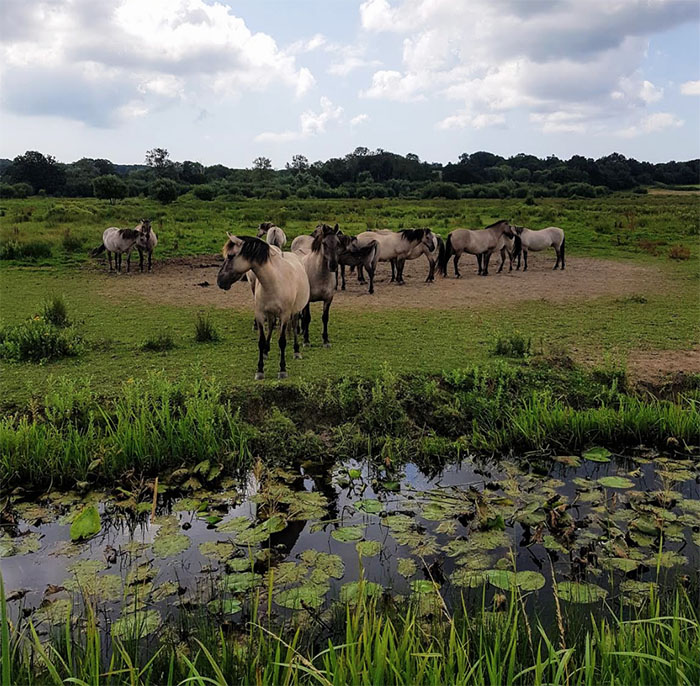
It is peaceful here. A silent retreat, a place to be, to observe, to feel small. This is sympathetically managed land, largely left to its own devices. Sensitively grazed by a small herd of Shetland Cattle and wild Konik ponies, its conservation strategy echoes that of other local areas like Friston Forest. There is a demonstration here that although it feels like the land is untouched, this is a joined-up attempt at getting the best from this place; giving nature the best chance. Through minimal intervention, Philip has created thriving wetlands here, havens for birds, insects and arachnids whose habitats are ever decreasing in other parts of the UK. There are wildflower meadows rich with life and woodlands where aerial friends can rest.
Zipping through this place on Philip’s nature safari, three hours passes in the blink of an eye. We stop every few hundred yards; something else to look at, something else to learn. My heart is full here, my mind still. I recall many of the health research papers exploring what makes a healthy place. This has so many of the perceived sensory dimensions associated with health promotion; serene, space, nature, rich in species*. Perhaps that is why I feel as I do.
Driving away, thinking about the wonder of this place, there are three things I take away.
One. let it never be said that a single person can do too little. We cannot all build a 350-acre legacy but the way we tread our paths with nature, lift our heads to see it and open our minds to learn about it can have a greater impact than almost anything else.
Two. Here is, yet again, another argument for light touch, re-wilding, doing more by doing less. Our clipped verges and mown lawns are traditional in their design but do not bring with them abundance. We need to think differently about design, about maintenance and perhaps about beauty itself. After all, with regard to nature; with abundance comes beauty.
Three and perhaps the poignant lesson here. This may be a private nature reserve, but it isn’t a private enterprise. Philip shares it with conservation experts; individuals with their own agendas from increasing rare spider populations to recording birds and also with larger organisations like the Sussex Wildlife Trust who can use this place to research and record. This is a personal project but a future one too, it is his desire that, in time, this place will end up in the hands of a wildlife conservation organisation and wheels are already in motion for this to happen. The legacy of this place will live well beyond its architect. And in todays’ world that is truly innovative and truly forward thinking. What we need to do now, is create places that aren’t for us but instead that live beyond us. And surely, we as landscape architects are some of the best placed professionals to do that…
*Stigsdotter and Grahn (2010) The relation between perceived sensory dimensions of urban green space and stress restoration. Landscape and Urban Planning. 94: 3-4
I am privileged to have known Philip Newton from the beginning of Maxfield and have witnessed the development of this beautiful landscape. It has been as you rightly described a work fuelled by his passion for wildlife and genuine love of nature in it’s purest sense. A remarkable achievement.
We really enjoyed meeting him. His passion is completely infectious.